Showing posts with label History. Show all posts

Wednesday, 4 September 2013

Weoley Castle

Weoley Castle is an area of South Birmingham which has the remains of an old fortified manor house. Not much remains of the house, but the bases of the stone walls can be seen. There’s more to see here than at Hawkesley House!

Weoley Castle is not a castle as such; it was a manor house that had curtain walls and a moat and it was inhabited since the 12th century. You can read more about the history here or there is a very comprehensive history here.


Covert shot taken through the railings ;-)


Unfortunately, Weoley Castle ruins are closed off to the public except on open days and guided walks. There is a ‘Talk and Walk’ Day on September 7th that I’ll be going to!  The walls can be seen from a viewing platform (and some can be seen from the track that goes along the back of the site, as I discovered by accident!) Weoley Castle is operated by the Birmingham Museums Trust.

A few more pics, from around t'interwebs:

Source

Source

Weoley Castle can be found on Alwold Road, B29. The 29 bus goes past the site, from Northfield high street, or the City Centre (by St Phillips Cathedral/Pigeon Park). Maybe I'll see some of you at the Talk and Walk day on September 7th?

Thursday, 31 January 2013

Big Brum Buz Tour!


During Artsfest 2012, my friend and I decided to go on the open top Buz!


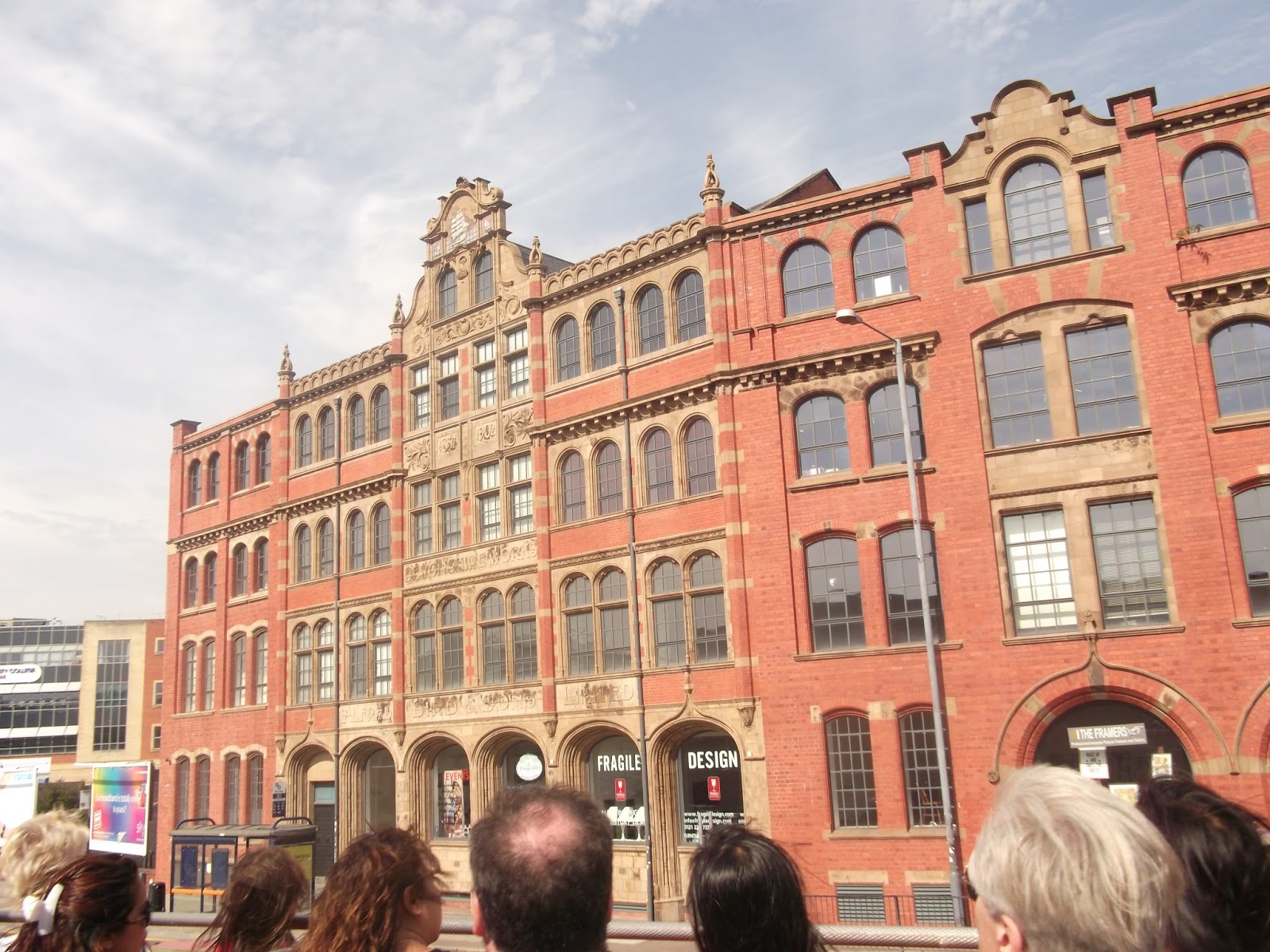
It was a lovely, sunny (hot!) day – yes we did have sun last year – and the top deck of the bus was full. We set off from outside the Council House and began our tour! I was sat near the back of the bus so most of the pictures feature backs-of-heads, and any attempt at getting pictures have buildings have resulted in photos of the top storeys only.

We went along Waterloo Street and Newhall Street first – the architecture around here is amazing! I need to spend more time looking up in this City.


A little while later, we passed a building with a pelican on the top of it! The man doing the commentary on the bus said that the pelican was placed here so the delivery boys would know which building to go to – hardly anyone could read, so buildings had different identifying features on them! Very clever.


After passing through the Jewellery Quarter, we headed down towards Edgbaston via Broad Street. 


We went down the Hagley Road and saw J.R.R Tolkiens house!


On the way back into the City, we passed a delightful building just off Camp Hill Middleway – The internet tells me it is called Stratford House (because it is on Stratford Road), and it was built in 1601! You can read a bit more about it here – I hope to go back and get some better photos of it sooner rather than later!


We then came back in Birmingham via Deritend and Digbeth, where we saw even more examples of grand architecture!


I’d recommend the Big Brum Buz tour if you’re interested in the history of Birmingham – it only took about an hour so it’s not very in-depth information, but it’s enough for you to want to dig and find out more. It’s also a good whip around the city for finding new places to explore, or places to photograph. All in all it was a good way to spend some time, especially with decent weather – but watch out for the low trees!

Wednesday, 23 January 2013

Northfield Railway Station


Northfield railway station gets a blog post all of its own because I think it’s rather spectacular. It has 4 platforms, but only two are used. It has bricked up subways (that most people don’t know exist) and has completely changed in the ~140years it’s been here.

When the station first opened in the late 1800s, the passenger trains originally used the central platform, with the outer tracks being used for freight. Platforms one and four didn’t exist then! Access to the central platform was gained via the subway under the bridge on West Heath Road (near the petrol station) – you can still see the bricked and boarded up holes today (the other is in the subway at the ticket office end). At the time, Northfield wasn’t part of Birmingham, so the railways brought people, jobs and goods to the rural areas, and subsequently modern Northfield built up around this.


The passenger subway at the ticket office end is now the only subway here, and it has recently (late 2012) had a refurb – lifts have been installed, more lighting, steps and hand rails. There are also two strips of neon green ‘stuff’ on the floor. One of these patches covers the numbers ‘1892’.  My brother (who is a train geek) and I have decided that this date marks the opening of the subway, as the station as a whole was already open for a while before this.


I love looking at old pictures of this area and seeing how little it has changed – the road layouts are pretty much the same, and you can really imagine what the area was like one hundred years ago. Some old photos of the station can be seen here and here.

Thursday, 29 November 2012

Birmingham in the 1300s

At the Birmingham Museum and Art Gallery, there is a new exhibition about Birmingham, called 'Birmingham: its people, its history'. I haven't yet been to it but I've been reading the blogs of a curator there (read parts one, two and three by following the links). Part of this gallery contains a model of Birmingham - the detail in it is amazing - and they have just published a video blog-fly through of the model. It is on youtube here, but I have also embedded it below.

Exploring Medieval Birmingham 1300

After seeing the video, I want to go visit the exhibition even more!

Saturday, 17 November 2012

Hawkesley Hall; King’s Norton


One day, I was doing a volunteering shift at Stirchley Stores with a rather nice man called Steve. We were talking about this blog and he asked if I knew anything about Hawkesley Hall. I said, I’ve never heard of it, which was true. Fast forward a few weeks to a day when I decided to go and find it, and I’m quite pleased that I have! There are no remains on the site, so if the signs weren’t here you’d have no idea. There are carved stone blocks with minimal information on, but to someone who doesn’t know, this area just looks like a patch of trees in the middle of an estate.


Hawkesley Hall is possibly the sister manor to Hawkesley House on Turves Green – the former being Little Hawkesley and the latter being Great Hawkesley. There is a chance that the former was the first home of the Hawkeslow family, and then they upgraded and moved to Turves Green. I wish I could claim to be a genius and know all this, but a lot of my information is from here and here.


There is a path around this site, and it supposedly follows the line of the moat. I like this idea; you can walk around the perimeter of the property before taking the path that would lead up to, and now through, the house.


It would be very interesting to know more about this – what the original house would’ve looked like, what the surrounding area would look like, how the Victorian house that was built on the same land would look like etc. I love peering into the past at old buildings and imagining how the world has changed so much in that one location!


Lime Tree Walk


To get to this location, you need to aim for the Hawkesley Estate. I walked up from the canal, but the 45 stops a 5 minute walk away, and the 35 and 27 also stop nearby. Once again, check out my brilliant Google Earth Map to find out more!


Thursday, 25 October 2012

University of Birmingham Blue Plaque; Charles Lapworth


"University of Birmingham. Charles Lapworth, undertook pioneering work into the formation of mountain belts, 1882-1883"

He also went crazy doing so.

The Earth Sciences student society is named LapSoc (Lapworth Society) in his honour, though this is routinely changed with some sort of pun for their socials (Lashworth, Lapizza, Lapsausage etc.) The Museum is also named after him.

This plaque can be seen on the wall of the Lapworth Museum of Geology at the University of Birmingham, main campus.